

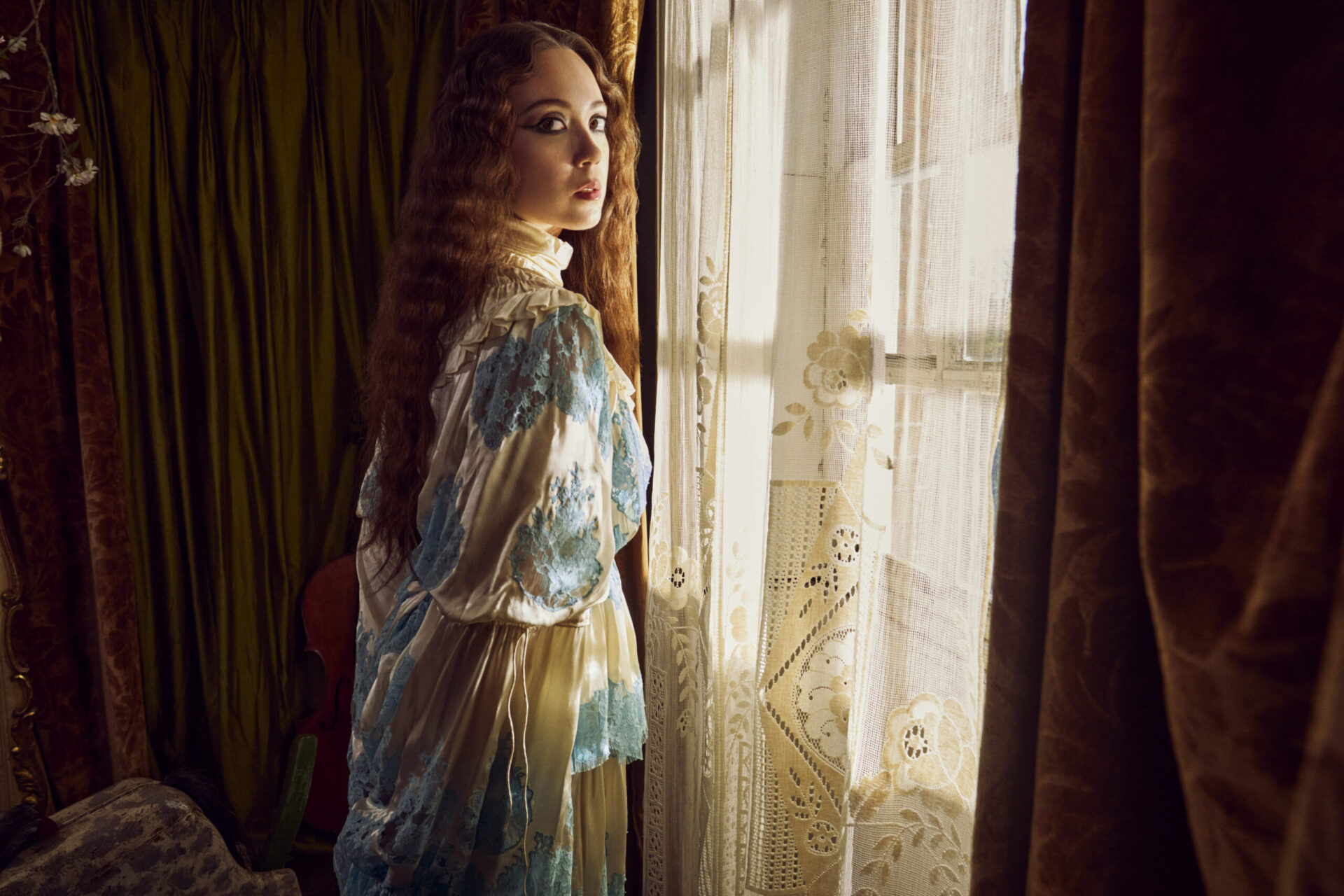
Laufey (pronounced LAY-vey) has built a career around turning ordinary feelings into something cinematic, so arriving at Spark Arena on 12 August felt less like heading to a concert and more like stepping into the opening scene of a film.
Inside, the mood was soft and expectant. Fans had dressed for the occasion, filling the arena with the sort of carefully considered outfits that have become an essential part of the Laufey experience. Then the lights went down, and the evening began with a reminder that sometimes the simplest setup can make the biggest impression.
Against a lovely red curtain backdrop, Leonie Biney walked onto the Spark Arena stage with little more than a guitar and her voice. No grand production. No wall of screens. No orchestra waiting behind her. Just a singer standing in front of thousands of people, asking them to listen. And they did.
There was an understated confidence to Biney’s set. Her songs felt intimate enough for a small room, yet she managed to stretch that feeling across an arena without making it seem forced. That isn’t an easy trick, an arena can swallow quiet music whole if an artist isn’t careful—but Biney held the room through sheer vocal power and sharp songwriting.
The proof came when she prompted the crowd to raise their phone torches without being asked. Suddenly, thousands of little lights appeared across the darkness. It was a small moment, but a telling one: an opener doesn’t usually command that kind of response unless they’ve genuinely made a connection. Without fireworks or gimmicks, Biney did the job the old-fashioned way: she sang, she played, and she made people care, leaving the room softened for what was to come.
Then came Laufey.
Structured in five distinct acts, the main show carried a distinctly theatrical pulse. Rather than a standard collection of songs played back-to-back, the night unfolded like a narrative, with each section carrying its own mood, costume, musical language, and visual identity.
The production was enormous, yet strangely cosy. That contradiction sits at the very heart of Laufey’s appeal. She is now filling arenas, yet her music still belongs in a candlelit jazz club, a bedroom at midnight, or an art-house cinema where everyone has forgotten to check their phone. The challenge, then, is how to make that level of intimacy work in a room built for spectacle.
The answer lay in the stage design. Mist rolled across the floor until the physical edge of the stage disappeared, making the stairs and central podium appear to float somewhere above the clouds. Tall arches gave the set an old fairytale, almost medieval quality, while the large screen behind it shifted through elaborate, storybook artwork. At times, it genuinely looked as though a Disney film had collided with a circus, a medieval fantasy, and a jazz club. It sounds absurd on paper, but somehow, it worked seamlessly.
The band and dancers heightened the theatricality, while Laufey moved effortlessly between piano, guitar, and cello. The musicianship was never treated as background decoration; the strings, in particular, gave the arrangements a richness that made the massive arena feel remarkably tight and close. If there was one slight frustration, it was that the dancers deserved more light. Their choreography was often stunning, but they occasionally disappeared into the production when they should have been given space to shine. Still, the sheer visual ambition was impressive.
And then, of course, there was Laufey herself.
One of her most charming qualities is how much she talks. She rambles, she digresses, she explains her process, she laughs at herself, and wanders through thoughts that wouldn’t survive a tightly edited press interview. Yet that is precisely why her connection with the audience feels different. She doesn’t speak like someone delivering polished celebrity soundbites. Even when her comments about loving New Zealand and appreciating the effort fans had made felt rehearsed, there was undeniable sincerity underneath them.
That intimacy matters because the songs themselves carry such emotional weight. “Promise” was the clearest example. The arena fell dead silent as Laufey sang, her falsetto soaring above the stage mist. There was no need for a singalong or a big visual cue—just her voice. For a moment, thousands of people stood completely still. It was haunting, atmospheric, and vocally sublime. Laufey can make a massive room feel as though it has shrunk to the space between a singer and a single listener.
Later, during “Madwoman,” her twin sister Junia joined her on stage on violin, earning a massive roar from the crowd—another reminder that family, musicianship, and fandom all sit comfortably inside Laufey’s world.
Then came Mei Mei. The bunny mascot appeared midway through the show to select four of the night’s best-dressed fans. This particular group had gone beyond wearing a nice outfit: they arrived in pyjamas with props spelling out the lyric “While You Were Sleeping, I Fell in Love”—a nod to the cult favourite from Bewitched. It was silly and creative, but most importantly, it felt like something made by fans, for fans.
That is where the entire show starts to make sense. Laufey isn’t simply performing to an audience; she has built an immersive universe, and her fans have happily moved into it.
Musically, the five acts traversed jazz and classical textures, pop hooks, and full theatrical arrangements. Some sections landed harder than others, but the progression kept the night moving. The final act proved the strongest, followed closely by Act Four and Act One, with Acts Two and Three rounding out the evening. Even the quieter sections served a purpose, giving the larger moments somewhere to build toward.
The emotional weight kept compounding. That is perhaps the most remarkable thing about Laufey live: her performances are so openly emotional that the surrounding machinery—the costumes, screens, mist, and arches—falls away when she sits down and sings. You simply listen.
And that might be the real achievement of the A Matter Of Time Tour. It doesn’t matter that Laufey is now big enough to fill arenas; she hasn’t allowed the arena to become the point. The point is still the song. The point is still the voice. The point is still that slightly awkward, deeply human feeling of hearing someone describe an emotion you thought belonged only to you.
By the final act, the grand production felt less like a spectacle and more like a backdrop for that connection. Outside, the Auckland rain seemed fitting—grey and wet—while inside Spark Arena, everything had become warm, strange, and impossibly romantic.
Calling the concert a jazz show would be too narrow. Calling it a pop concert wouldn’t quite capture it either. It felt as though Eurovision, Cirque du Soleil, an old Hollywood musical, and an intimate songwriting session had all decided to share the same stage. And somehow, it was still unmistakably Laufey.
Walking back out into the night, the whole thing felt slightly unreal. Two hours earlier, the venue had been a concrete box. Now, it felt like somewhere else entirely. A fairytale, perhaps. A little theatrical, a little ridiculous, very beautiful—and, most importantly, something that will linger for a long time.
0 Comments